
Xinan Ran | A Legend of Sorts
Opening on Thursday, January 14, 2027, from 6–8pm
On view January 14 - March 6, 2027
Xinan Ran first encountered the word “Mandarin” in 2011 when she first arrived in North America. Without much explanation, she felt the word was assigned to her, to describe her mother tongue in English. Ran now has a growing suspicion that her affection for 桔, the easy-to-peel mandarin orange, has been shaped by its shared name with the term used to identify her in the US.
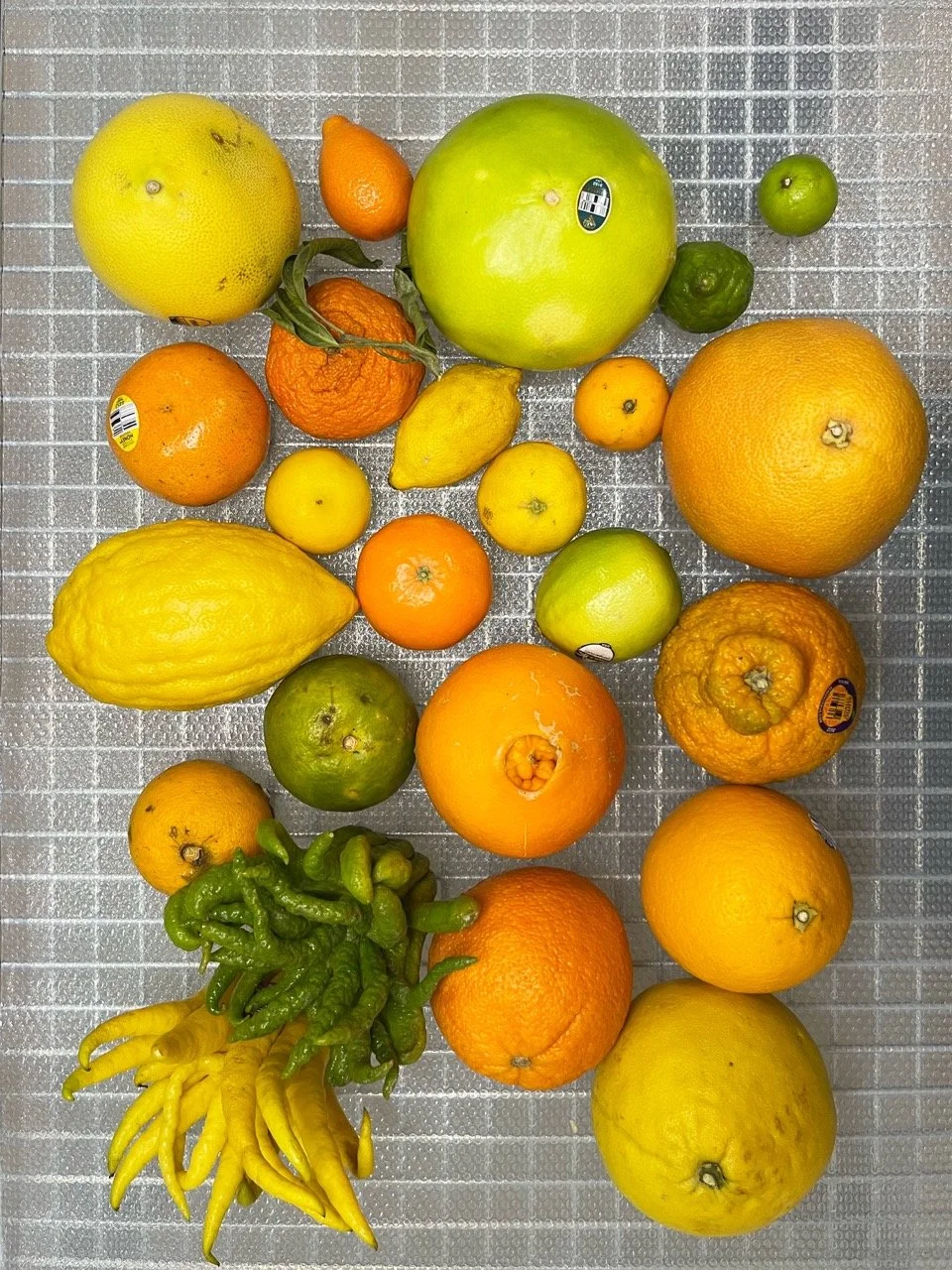
This suspicion led Ran to research the citrus family’s unusually convoluted genealogy, where lineages overlap, reconnect, and cross-reference one another. From ancestral citrus varieties across Asia—mandarin, pomelo, and citron—to the hybrid fruits that populate today’s supermarket produce aisles, citrus carries a history of migration, adaptation, and reinvention. Its genealogy offers a parallel to migrant identity in a new land, where interconnected histories confound fixed categories.
The exhibition, A Legend of Sorts, extends Ran’s research into the limits of legible representation. Through an installation of sculptural objects, dried and fresh materials, instructional text, and diagrams that one can follow and activate, the project explores nonlinear, visceral approaches to knowing. In the process, Ran makes the invisible tactile, while questioning what is lost or rendered illegible along the way. How might one share something without making it easily retold by others?
The Champion Orange Peeler Tower stands at the spatial center of the gallery. The work is a speculative recreation of an orange-peel tower demonstrated by a mysterious “Mr. Birch,” a British ship cook who had a knack for carving ornamental oranges, as published and demonstrated in the December 1899 issue of The Strand Magazine, also on view in the exhibition. The sculpture consists of 100 carved and sculpted orange peels stacked atop one another.
Throughout the gallery, a wide variety of fresh citrus fruits are scattered across the floor. Each fruit bears a unique label corresponding to other works in the space, forming a physical legend of sorts. The labels invite visitors to navigate the installation through a system of references that connects individual fruits to images, objects, histories, and encounters elsewhere in the gallery. The dispersed legend asks visitors to construct their own relationships between the parts.
On the back wall, a citrus family tree overlaps a mapping of scores. Together, they guide viewers through archival materials tracing citrus history across the Americas, questioning what constitutes a meaningful record: ancestry, historical dates, genetic connections, personal associations, or encounters that leave no trace.
On the front walls of the gallery, Ran showcases a collection of world maps, first tattooed onto the oranges, then peeled by acquaintances of Ran, with exchanges taking place through the mail. Orange peels are often used to explain the foundational concept of “projection” in cartography—why it is mathematically impossible to flatten a 3D sphere into a 2D map without distortion. Cartographic projection becomes a metaphor for the inherently biased process of transforming unstable and often incoherent realities into something that can be classified, measured, and administered. After all, we peel oranges so differently.
Xinan Ran creates scalable, research-driven installations and searches for the point where trauma, nihilism, and humor converge. Ranked “Highbrow and Brilliant” by the New York Magazine Approval Matrix, she is a MacDowell Fellow, a More Art Commission artist, and a NYSCA grant recipient, with exhibitions nationally and internationally. Xinan Ran received her MFA from Hunter College and her BFA from Pratt Institute. She is an arts educator, set designer, and arts worker based in Brooklyn.
Image: Georgia O'Keeffe, Hands and Thimble by Alfred Stieglitz, 1919